5 min read
Learning English in Ireland: why a school in Gorey, not just a course in Dublin
What makes learning English in Ireland different — small classrooms, project-based teaching, CEFR certification, and a town where the language never switches off.
Ireland has been welcoming international students to learn English for nearly seventy years. The clichés are mostly true — the country is friendly, the rain is real, the language is in the air. What’s changed in the last decade is the format. Big city schools and 200-student summer factories are getting the bulk of the headlines, but they’re rarely the best place to actually learn.
We opened Gorey School of English because we wanted to do it differently. Here’s what that means in practice.
A school, not a holiday
It’s an obvious thing to say and a surprisingly rare thing to deliver. We are a school first: registered, structured, with a curriculum, qualified teachers, written feedback and certificates. The activities and the host families and the surf lessons matter — they’re the reason you choose Ireland over a textbook — but the classroom is where measurable progress happens, and we treat it that way.
What that looks like:
- Placement on day one. Every student takes a written and oral assessment when they arrive and is streamed by CEFR level (A1 through C1). Groups of mixed ability are kind of pleasant for everyone except the people in them — we don’t do them.
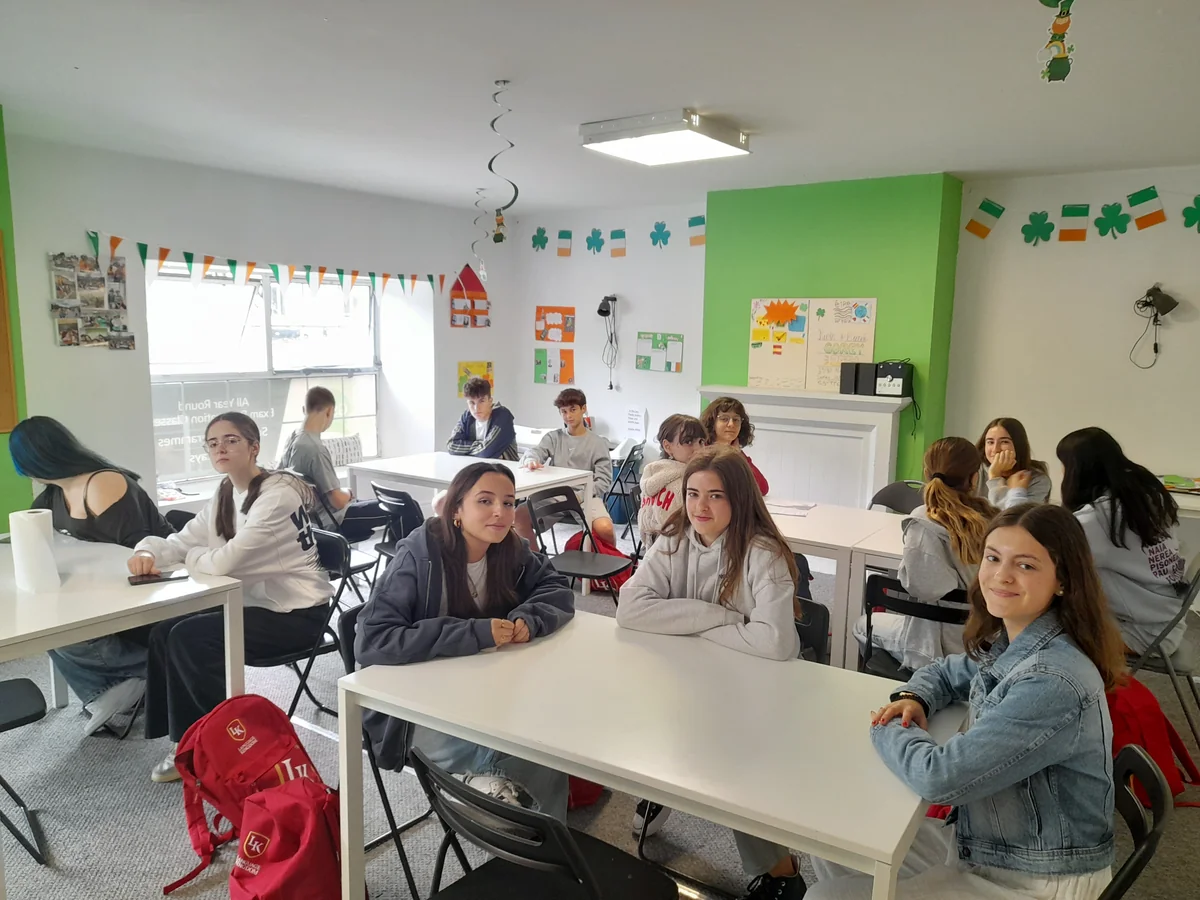
- Small groups. Streamed by level so everyone is working at the right place. Small enough that the teacher actually knows where each student is and that everyone speaks every day.
- Three hours every weekday morning. That’s 15 hours per week — the level of contact you need to actually move a level on a long stay, and to consolidate what’s there on a short one.
- Written feedback through the week. End-of-week assessment, plus a certificate of attendance with the student’s CEFR level on departure. That’s a piece of paper that actually means something to a school back home.
Project-based, not page-based
A lot of language teaching in 2026 is still built around gap-fill exercises and grammar drills. They have their place, but they’re not what makes a 14-year-old want to speak English on a Tuesday afternoon. Our classrooms are project-based — students use the language to build something:
- Group projects with a deliverable at the end of the week — a mini-podcast, a poster campaign, a short film, a debate
- Role-plays from real Irish life — ordering at a café, asking for directions, arranging a meet-up, dealing with a misunderstanding
- Drama and music — short performances, song-writing, simple acting workshops, all with English as the working language
- CLIL-style content lessons — geography, history, biology, sport, taught in English so the language is being used to learn something else
That’s not pedagogy for the sake of it. It’s the format we’ve found gets students from “I understand a bit” to “I can hold a real conversation” fastest.
A whole town that speaks English
Methodology only takes you so far if students switch back into their first language the moment class ends. Gorey is the answer to that. It’s a working Irish market town of about 10,000 people. There is no expat bubble, no language-school district, no parallel world where students from one country all hang out together. Walk into a café at four in the afternoon and the only language available is English.
This is the part of “studying English in Ireland” that you can’t manufacture in a city, and that’s why we’ve built our school around it. Mornings in class, afternoons in town, evenings with a host family — the language never switches off.
What we teach
We run general English as the spine of every programme, with optional tracks layered on top:
- General English (A1–C1) — the default for most ministays and summer programmes
- Cambridge exam preparation — B1 Preliminary, B2 First, C1 Advanced
- Trinity GESE/ISE preparation — speaking and listening or full four skills
- Conversation-focused courses — for students who have the grammar but freeze when they have to speak
- CLIL / academic English — for students preparing for an academic year abroad
- Sport + English combinations — surf, hurling, Gaelic football, with vocabulary built around the activity
Students on longer stays can switch tracks mid-programme if their goals change, and we issue a single, integrated certificate at the end.
Who’s teaching
All of our teachers are qualified ESL professionals — degree, CELTA or equivalent, and classroom experience teaching juniors. We pay them properly, train them continuously, and don’t ask them to also be activity leaders, drivers and chaperones. The teaching team teaches; the activity team runs activities; the operations team runs the operations. Clarity of roles is part of why our methodology actually translates into the classroom.
How we measure progress
We don’t believe in vague reassurances. Every student leaves with:
- A written end-of-programme report from their teacher, against the CEFR descriptors
- A certificate of attendance stating their entry level, exit level and total contact hours
- A portfolio of work from the week — projects, recordings, photos of presentations, the bits we know parents and home schools actually want to see
For longer stays, we run mid-stay reviews with parents or the home school, and adjust the timetable if a student needs a different level or a different focus.
The small things
We’re aligned with the EAQUALS framework on quality (teacher hours, qualifications, accommodation standards, complaint handling), and our programmes are reviewed in writing every season. Host families are Garda-vetted, visited, and matched on more than just availability. Activity leaders are first-aid trained and run programmes built around safeguarding policies that are reviewed every year.
None of this is glamorous. It’s the boring infrastructure that decides whether a programme works on the bad days, and we’d rather have it sorted up front than improvise.
What it’s not
We’re not a 200-student campus. We’re not a coach-tour operation. We’re not a programme where students fly out, take a few classes, and come home with a fridge magnet. If a school is looking for a name to put on a brochure, we’re probably not the right fit.
But if you’re an agency or a school that wants juniors to actually move a CEFR level, with a measurable certificate to show for it, in a country where the language doesn’t switch off when class ends — that’s exactly what we built this school for. Get in touch and we’ll send you the details.